
Perhaps the fastest way to enter IT in Kazakhstan in 2023 is programmable networks and systems—one of the most promising areas of the information technology sector. To get started, you only need to master the basics of the following areas: system administration, network engineering, and, most importantly, programming. Today, we'll cover integer data in Python , a topic included in the DevOps/DevNet specialist courses in Astana.
What is an integer data type (int), DevOps / DevNet specialist courses Astana
First, let's understand what integer data types are. It's worth noting that they are used in virtually all programming languages, with the possible exception of the more exotic ones that have no direct practical application. For more information on which programming languages are in demand in the job market today, check out the DevOps / DevNet torrent courses in Astana.
Integer data is any whole number, both positive (natural) and negative. These numbers have no fractional (after the decimal point) or imaginary parts. Examples of integer data in Python include:
- the number of characters in a string, list, tuple, or dictionary elements;
- number of lines in text;
- number of loop iterations for и while;
- the result of arithmetic operations between integers (in this case, you will not get a fractional part if one of the operands is not of the real type).
To indicate to the interpreter that you want to assign a value corresponding to an integer type to a variable, use the int() class . It's worth noting that when entered from the keyboard, the input() operator treats the data as a string ( str ). By defining it as int() in advance , you'll receive an integer instead of a string containing digits. For more information, please visit our DevOps / DevNet specialist courses in Astana on the SEDICOMM University platform.
Examples of using integer data type in Python
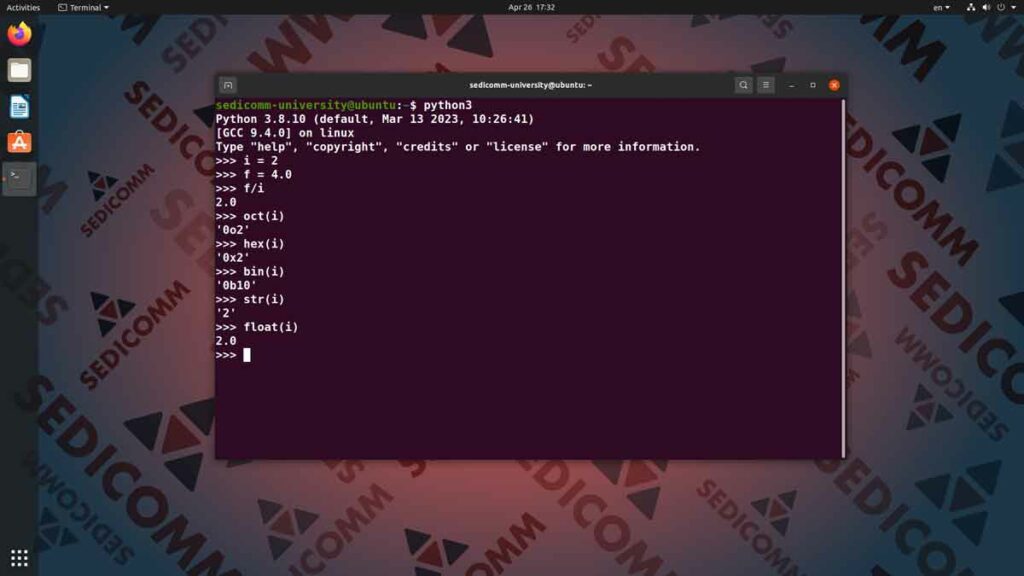
It's worth noting that the Python programming language supports working with integers represented in different number systems besides the standard decimal:
- bin(x) - converts the value to binary and turns the result into a string;
- hex(x) — converts the value to hexadecimal and turns the result into a string;
- oct(x) — converts the value to octal and turns the result into a string.
As we wrote above, integers can be used in arithmetic operations. For example, in addition, subtraction, multiplication, division, obtaining the module, raising to a power. It is worth noting that if an integer is not divisible by another integer, the result will be 0. For example, if you try to divide 2 by 4. If the number is not divisible without a remainder, the result will simply not take it into account.
In addition, the result of some operations (for example, raising to a power) can be a very large integer. It is worth noting that the mass use of such values in the program significantly increases the load on the computer's RAM. Therefore, they should be used rationally, only when necessary.
You can learn more about this and much more in the DevOps / DevNet torrent courses in Astana . This is likely the easiest way to become an IT specialist in Kazakhstan in 2023. Leave your questions in the comments about other ways to use integers in Python ! Also, share any surprising results from operations with them.
SEDICOMM University Team : Cisco Academy , Linux Professional Institute , Python Institute.